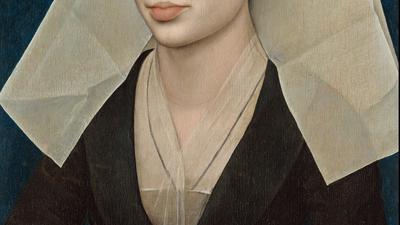
In this quiet moment, we encounter the Portrait of a Young Girl, a masterpiece of the Northern Renaissance painted around 1470 by the Flemish master Petrus Christus. Though centuries have passed, her presence remains strikingly immediate. Look closely at her gaze. She does not look past us; instead, her eyes are fixed directly on ours with a mix of curiosity and composure. She sits in a sparse, wood-paneled room, her pale skin glowing softly against the dark, velvet shadows of the background. Her posture is elegant and upright, dressed in a sumptuous blue gown with a delicate lace collar that traces the line of her neck. On her head sits a stylish black headdress, its sharp silhouette contrasting with the gentle curves of her face.
The artistry lies in the exquisite use of light. A soft glow falls from the left, illuminating the porcelain texture of her skin and catching the fine gold threads of her jewelry. Petrus Christus has abandoned the flat backgrounds of his predecessors, placing her instead in a three-dimensional space where light and air seem to circulate. Every brushstroke is invisible, creating a surface as smooth as glass. This portrait is more than a likeness; it is an intimate psychological study. There is a magnetic stillness here, a sense of a private world momentarily shared. Her slight, enigmatic expression invites us to wonder about her thoughts, bridging the gap between the past and the present. It is a timeless encounter with a girl whose name is lost to history, yet whose spirit remains vividly alive.