The Pictorial Legacy of Thomas and William Daniell: Chroniclers of Empire and Landscape
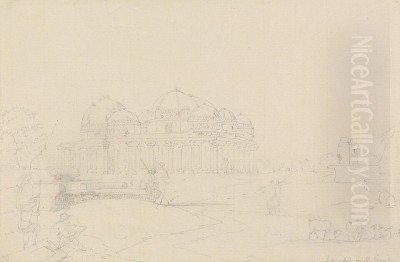
The late eighteenth and early nineteenth centuries witnessed a burgeoning British interest in the wider world, fueled by exploration, trade, and the expansion of empire. Within this context, the artistic contributions of Thomas Daniell (1749-1840) and his nephew William Daniell (1769-1837) hold a significant place. These intrepid artists embarked on extensive travels, most notably to India, and later William around the coast of Great Britain, producing a vast corpus of work that not only captivated their contemporaries but also provided invaluable visual records of landscapes, architecture, and cultures. Their meticulous use of watercolour and mastery of the aquatint engraving process allowed them to disseminate their visions widely, shaping perceptions and leaving an indelible mark on the history of British art and its engagement with the "Orient" and the domestic picturesque.
Thomas Daniell: Early Life and Artistic Foundations
Born in Kingston upon Thames, Surrey, in 1749, Thomas Daniell's early artistic training was relatively conventional. He was apprenticed to a coach painter, a trade that, while seemingly modest, provided a solid grounding in draughtsmanship and the application of colour. He later progressed to study at the prestigious Royal Academy Schools. During these formative years, he would have been exposed to the burgeoning English school of landscape painting, with artists like Richard Wilson laying the groundwork for a native tradition, and the watercolourist Paul Sandby, known as the "father of English watercolour," popularizing the medium for topographical views.
Thomas Daniell began exhibiting at the Royal Academy in 1772, initially showing architectural subjects and landscapes. His early works, though competent, did not immediately set him apart in a competitive London art scene. However, a desire for new subjects and perhaps greater professional opportunities began to take root. The allure of India, a land of fabled riches, ancient civilizations, and exotic landscapes, increasingly under British influence through the East India Company, presented a compelling prospect for an ambitious artist.
William Daniell: A Nephew's Apprenticeship and Early Promise
William Daniell was born in 1769, also in Kingston upon Thames. His father, a bricklayer, passed away when William was young, and his upbringing and artistic education were largely overseen by his uncle, Thomas. From an early age, William displayed a talent for drawing and was taken on as Thomas's apprentice. This was a common practice, where the master would impart skills and knowledge directly to the pupil through practical involvement in studio work.
When Thomas Daniell made the momentous decision to travel to India in 1785, he took the then sixteen-year-old William with him as his assistant. This journey would prove to be the defining experience of William's artistic life, providing him with unparalleled opportunities to learn, observe, and hone his skills under his uncle's direct tutelage in challenging and inspiring environments. The master-apprentice relationship would evolve into a true artistic partnership during their years abroad.
The Grand Indian Venture: A Decade of Discovery
In 1784, Thomas Daniell successfully petitioned the East India Company for permission to travel to India as an engraver. He and William set sail from Gravesend in April 1785, arriving in Calcutta (now Kolkata) via China the following year. Calcutta, at that time, was the burgeoning capital of British India, a hub of commercial and administrative activity. The Daniells' arrival marked the beginning of nearly a decade of travel and artistic production across the Indian subcontinent.
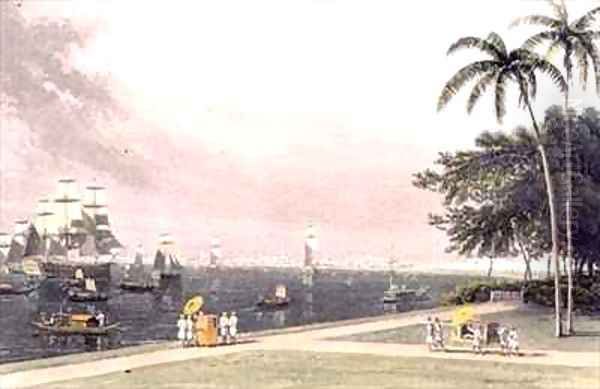
Their initial period in Calcutta was spent establishing themselves and undertaking commissions, including a series of twelve views of the city executed in etching and aquatint. However, their ambition extended far beyond the confines of the colonial capital. They embarked on a series of arduous journeys, often under difficult conditions, that took them up the Ganges River, through northern India to regions like Delhi, Agra, and Garhwal in the Himalayas, and later to southern India, visiting Mysore, Madurai, and the rock-cut temples of Western India. They also briefly visited Ceylon (Sri Lanka).
Artistic Methods in the Field
The Daniells' primary method for capturing the scenes they encountered was through on-the-spot pencil sketches and watercolour drawings. They were keen observers, meticulously recording architectural details, topographical features, and aspects of local life. It is documented that they made use of a camera obscura, a device that projects an image onto a surface, aiding in the accurate depiction of perspective and detail. This tool was increasingly popular among artists undertaking topographical work.
William, though initially an assistant, rapidly developed his skills. He was responsible for many of the initial sketches and watercolours, often working alongside his uncle. Thomas, with his greater experience, would then refine these studies, preparing them for the subsequent process of engraving back in Britain. Their collaborative efforts in the field were crucial to the sheer volume and quality of the material they amassed.
Oriental Scenery: The Magnum Opus
Upon their return to England in 1794, Thomas and William Daniell embarked on the monumental task of translating their vast collection of Indian sketches and watercolours into a form suitable for wider public consumption. The result was Oriental Scenery, a lavish and ambitious publication issued in six parts (or volumes) between 1795 and 1808. Each part contained twenty-four hand-coloured aquatint engravings, making a total of 144 plates, accompanied by descriptive letterpress.
This publication was a landmark achievement. Aquatint, a complex intaglio printmaking technique that allows for the creation of tonal areas resembling watercolour washes, was the perfect medium for reproducing the atmospheric effects and subtle gradations of their original drawings. Thomas Daniell was a skilled engraver, and William also became proficient in the technique. The hand-colouring of each print by a team of colourists further enhanced their visual appeal and fidelity to the original watercolours.
Collaboration and Division of Labour in Oriental Scenery
While Thomas Daniell was the senior partner and his name appeared more prominently, Oriental Scenery was very much a collaborative effort. William's contribution was substantial, not only in the initial fieldwork but also in the production of the aquatints. Many of the plates are explicitly credited to William, or based on his drawings. Generally, Thomas took the lead on the more complex architectural subjects, while William often focused on landscapes and scenes incorporating figures and daily life, though these distinctions were not rigid. The project's success relied on their combined skills and tireless dedication over more than a decade.
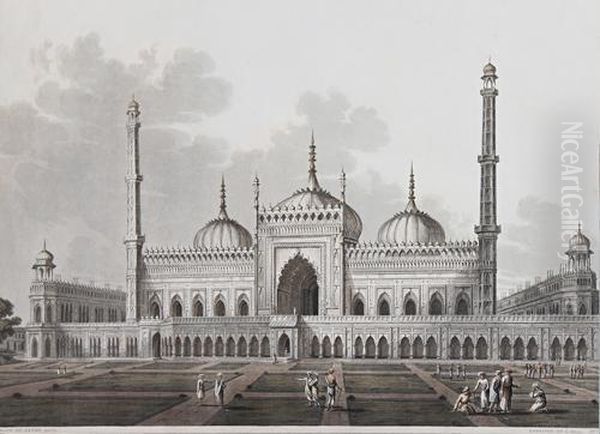
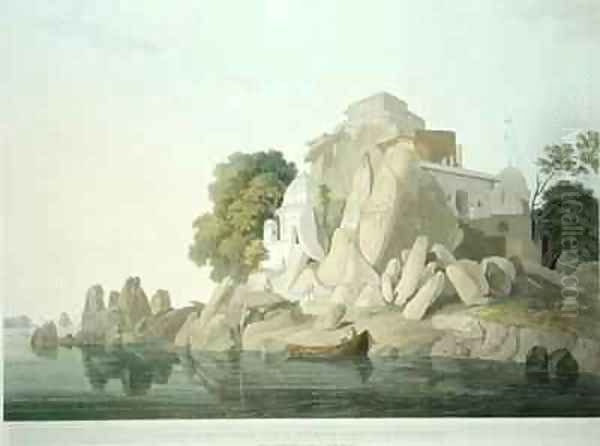
The subjects depicted in Oriental Scenery were diverse, showcasing the grandeur of Mughal architecture like the Taj Mahal and Fatehpur Sikri, the intricate carvings of Hindu temples, dramatic mountain landscapes of the Himalayas, bustling river scenes, and depictions of local customs and people. The work aimed to present a comprehensive visual survey of India, filtered through the aesthetic sensibilities of the late eighteenth-century British picturesque.
The Impact of Oriental Scenery
Oriental Scenery was an immediate success and had a profound impact on British perceptions of India. At a time when few Britons had travelled to the subcontinent, and visual information was scarce, the Daniells' prints offered a vivid and seemingly authentic window onto a distant and fascinating land. The scale and quality of the publication were unprecedented for a work on an "oriental" subject.
Shaping Western Perceptions
The images presented in Oriental Scenery helped to construct a particular vision of India in the British imagination – one characterized by magnificent, often decaying, ancient monuments, exotic natural beauty, and a sense of timelessness. This imagery resonated with the Romantic sensibilities of the era, which valued the sublime, the picturesque, and the melancholic beauty of ruins. Artists like J.M.W. Turner, though primarily focused on European and British landscapes, was certainly aware of such depictions of exotic locales, which contributed to a broader Romantic fascination with the remote and the historic.
The work was influential not only among the general public but also among architects and designers in Britain, contributing to the "Hindoo" style in architecture and decorative arts that enjoyed a vogue in the early nineteenth century. The Royal Pavilion in Brighton, designed by John Nash, is a prime example of this exotic architectural trend, likely influenced by images such as those produced by the Daniells.
The Picturesque and the Sublime in an Indian Context
The Daniells framed their Indian views through the lens of the picturesque, an aesthetic category popularised by writers like William Gilpin. This involved composing scenes with an eye for pleasing arrangements of forms, textures, and light and shade, often incorporating elements of ruggedness or irregularity. Many of their Indian landscapes and architectural views, with their crumbling edifices and dramatic natural settings, also evoked the sublime – a sense of awe and overwhelming grandeur.
Their approach contrasted with that of earlier artists who had visited India, such as Tilly Kettle or Johan Zoffany, who were primarily portrait painters catering to the European community. William Hodges, who was in India shortly before the Daniells, also produced significant landscape paintings and aquatints, but the Daniells' Oriental Scenery was more comprehensive and arguably more influential in its systematic documentation.
Colonial Gaze and Cultural Representation
It is important to acknowledge that the Daniells' work, while providing invaluable historical documentation, was produced within the context of British colonialism. Their perspective was inevitably that of outsiders, and their depictions, while often sympathetic, can be seen as part of a broader "Orientalist" discourse, as later theorized by Edward Said, where the East is represented through a Western framework.
The emphasis on ruins, for instance, could subtly reinforce a narrative of a once-great civilization now in decline, implicitly justifying British intervention and rule. However, their work also conveyed a genuine admiration for India's artistic and architectural heritage. The figures in their landscapes, while sometimes generalized, often add a sense of life and cultural specificity to the scenes. Their depictions of Indian people were generally more dignified and less caricatured than some contemporary European representations.
Return to Britain and Later Careers
The Daniells returned to England as established artists with a unique body of work. The success of Oriental Scenery brought them fame and financial stability, though the project was a significant investment of time and resources.
Thomas Daniell's Later Works and Recognition
After the completion of Oriental Scenery, Thomas Daniell continued to paint and exhibit, primarily Indian subjects based on his earlier sketches. He was elected a Royal Academician (RA) in 1799, a mark of high professional standing. His later oil paintings of Indian scenes, often large-scale and dramatic, were popular exhibits at the Royal Academy. He also produced works based on his brief visit to China. He lived a long life, passing away in 1840, recognized as a significant figure in British landscape and topographical art. His dedication to the Indian theme was unwavering, and his influence on younger artists interested in exotic subjects was considerable.
William Daniell's Independent Path
William Daniell, having come of age artistically during the Indian venture, forged a successful independent career upon his return. He was elected an Associate of the Royal Academy (ARA) in 1807 and a full Royal Academician in 1822. While he continued to produce Indian scenes, often collaborating with his uncle or working from their shared archive of sketches, he also diversified his subject matter.
#### A Picturesque Voyage to India by Way of China
In 1810, William Daniell published A Picturesque Voyage to India by Way of China, a smaller-format work with fifty hand-coloured aquatints based on his own sketches made during the outward journey to India. This publication further showcased his skills as both a draughtsman and an aquatint engraver, and it catered to a public eager for images of distant lands.
#### A Voyage Round Great Britain
Perhaps William Daniell's most significant independent achievement was A Voyage Round Great Britain, undertaken between 1814 and 1825. This monumental project involved William travelling the coastline of England, Wales, and Scotland, producing an astonishing 308 hand-coloured aquatints. The accompanying text for the initial volumes was written by Richard Ayton, though Daniell later took over the writing himself.
This ambitious survey captured the varied coastal scenery of Britain, from bustling ports and fishing villages to remote cliffs and islands. It was a patriotic undertaking, celebrating the nation's maritime character and natural beauty. The style of these aquatints is often softer and more atmospheric than the Indian views, reflecting evolving artistic tastes and perhaps William's own developing sensibility. He showed a keen interest in capturing the effects of light and weather, a concern shared by contemporaries like John Constable, who was revolutionizing the depiction of the English countryside with his fresh, naturalistic approach.
The Voyage Round Great Britain involved considerable logistical challenges. William often travelled by sea, sketching from boats, and endured various hardships. Anecdotes from the voyage include his collaboration and eventual parting of ways with Richard Ayton, reportedly due to disagreements over the style and length of the text. There were also financial considerations, as such a large-scale publication was a significant undertaking. His depiction of Armadale Castle on the Isle of Skye was noted by some as a "pictorial anachronism," as he drew it in an earlier state of completion than its actual state in 1815. He also tended to present a somewhat romanticized view of the Scottish Highlands, sometimes downplaying the social upheaval of the Clearances, which other travellers like Thomas Pennant had commented on more directly.
#### Other Works and Royal Academy Membership
Beyond these major publications, William Daniell was a prolific artist. He produced numerous watercolours and oil paintings of British and foreign landscapes, marine subjects, and even animal studies, influenced by artists like Sawrey Gilpin (who became his brother-in-law) and George Stubbs. He exhibited regularly at the Royal Academy and the British Institution. His marine paintings, in particular, were well-regarded, showing an understanding of ships and the sea that was likely honed during his extensive coastal travels. He also contributed illustrations to various books, including works on natural history. His election as a Royal Academician in 1822 solidified his position within the British art establishment. He passed away in 1837.
Artistic Styles in Context
The Daniells' artistic style was rooted in the British topographical tradition, which emphasized accuracy and detailed representation. However, their work also embraced the aesthetic principles of the Picturesque and the Sublime, which were central to late eighteenth and early nineteenth-century landscape art.
The Daniells and the Picturesque Tradition
Their compositions are often carefully structured, with attention to foreground interest, middle ground, and distant vistas. They skillfully used light and shadow to create mood and highlight architectural or natural features. The inclusion of figures, animals, and elements of daily life added vivacity and narrative interest to their scenes. This approach aligns with the picturesque ideal of creating visually engaging and varied compositions. Other artists working in a similar vein in Britain included Thomas Girtin, a contemporary of Turner, whose watercolours of British landscapes and architectural ruins were highly influential.
Comparisons with Contemporaries
While the Daniells were creating their detailed aquatints, British art was undergoing significant transformations. J.M.W. Turner was pushing the boundaries of landscape painting, moving towards increasingly abstract and expressive depictions of light and atmosphere. John Constable was developing his deeply personal and naturalistic vision of the English countryside. Compared to these titans of Romantic landscape painting, the Daniells' work might appear more conservative or documentary.
However, their aims were different. The Daniells were primarily concerned with conveying information about specific places, albeit through an artistic lens. Their use of aquatint was perfectly suited to this purpose, allowing for wide dissemination of their images. Their meticulousness can be compared to that of scientific illustrators, yet their work always retained a strong artistic sensibility. Artists like George Chinnery, who spent many years painting in India and China, shared the Daniells' interest in depicting foreign lands, though Chinnery's style was often more fluid and painterly in his oils and sketches. Similarly, William Alexander, who accompanied the Macartney Embassy to China, produced aquatints that documented that then-remote empire.
The Daniells' engagement with India also finds parallels with artists who documented other parts of the expanding British sphere of influence, or even those who explored continental Europe with a picturesque eye, such as Samuel Prout, known for his detailed renderings of European architecture.
The Role of Watercolour and Aquatint
Watercolour was the foundational medium for the Daniells. Its portability made it ideal for sketching in the field, and its transparency allowed for luminous effects. The development of the aquatint process provided a means to translate the subtleties of watercolour into print. The Daniells were masters of this technique, and their large-scale publications like Oriental Scenery and A Voyage Round Great Britain stand as monuments to the art of aquatint. The hand-colouring of these prints was a crucial final step, bridging the gap between the monochrome print and the full-colour original watercolour.
Legacy and Influence
The legacy of Thomas and William Daniell is multifaceted. They were pioneers in the visual documentation of India for a Western audience and significant contributors to the British tradition of topographical art.
Influence on British Art
Their depictions of India sparked an interest in "Oriental" subjects among other British artists and contributed to the Romantic fascination with exotic lands. Their meticulous technique and the sheer ambition of their publishing projects set a high standard for topographical art. William Daniell's Voyage Round Great Britain also played a role in fostering an appreciation for Britain's own diverse landscapes and maritime heritage. The detailed nature of their work influenced illustrators and those involved in recording expeditions, such as Captain James Cook's voyages, which also employed artists like William Hodges (before his Indian sojourn) and John Webber to document their findings.
Historical and Documentary Value
Beyond their artistic merit, the Daniells' works possess immense historical and documentary value. Their views of Indian architecture are often among the earliest accurate representations available and provide crucial information about buildings that may have since been altered or fallen into further ruin. Similarly, their depictions of landscapes, cityscapes, and daily life offer insights into the appearance and customs of India and Britain in their time. For historians of colonial India, their images are an indispensable resource, albeit one that needs to be interpreted with an awareness of its context.
Enduring Appeal
The works of Thomas and William Daniell continue to be admired for their beauty, technical skill, and the fascinating glimpses they offer into past worlds. Their aquatints are highly sought after by collectors, and their original watercolours are prized possessions in museums and galleries worldwide. Their adventurous spirit and dedication to their art, often pursued under challenging conditions, remain an inspiring story. They successfully bridged the gap between art and exploration, creating a body of work that informs, delights, and transports the viewer.
Conclusion
Thomas and William Daniell were more than just skilled landscape artists; they were visual chroniclers of an era of significant global change and British expansion. Their journeys to India, and William's later survey of the British coast, resulted in an extraordinary visual archive. Through their mastery of watercolour and aquatint, they brought distant scenes and grand vistas to a wide public, shaping perceptions and leaving a lasting legacy. Their work stands as a testament to their artistic talent, their adventurous spirit, and their dedication to documenting the world as they saw it, providing an invaluable window onto the landscapes and cultures of the late eighteenth and early nineteenth centuries. While their perspective was inevitably shaped by their time and background, the richness, detail, and artistic quality of their oeuvre ensure their enduring importance in the annals of art history.