The Van Eyck Brothers: Forging the Northern Renaissance
The fifteenth century witnessed a seismic shift in European art, a period of profound innovation and burgeoning realism that would lay the groundwork for centuries of artistic development. While Italy is often celebrated as the cradle of the Renaissance, a parallel and equally transformative movement was unfolding in Northern Europe, particularly in the prosperous cities of Flanders. At the vanguard of this Northern Renaissance were two brothers whose names became synonymous with meticulous detail, luminous color, and groundbreaking technique: Hubert and Jan van Eyck. Their contributions, particularly in the mastery of oil painting, not only defined the Early Netherlandish school but also cast a long shadow over the entire trajectory of Western art.
Hubert van Eyck: The Enigmatic Elder
The figure of Hubert van Eyck remains one of art history's more elusive yet significant personalities. Born around 1366, likely in Maaseik, a town in the Prince-Bishopric of Liège (modern-day Belgium), Hubert was the elder brother of the more extensively documented Jan. His life, though less chronicled than his sibling's, was foundational to the artistic legacy they would jointly and individually create.
Hubert's identity as a painter of considerable renown in his time is primarily anchored to his association with the monumental Ghent Altarpiece. Historical records, though sometimes sparse, indicate his presence and activity in Ghent. He is believed to have established a workshop there, laying the groundwork for the artistic environment in which both he and Jan would flourish. His death in 1426, specifically on September 18th, is recorded in Ghent, an event that predates the final completion of their most famous collaborative work.
The primary testament to Hubert's skill and vision is the very inscription on the Ghent Altarpiece, which names him as the one who "began" the work, and as "the greatest painter that was ever known." While the precise nature and extent of his contribution have been subjects of scholarly debate for centuries, his role as the initial conceptualizer and principal artist for a significant portion of the altarpiece is widely, though not universally, accepted. He was a master of his craft, recognized by his contemporaries as a leading artist, even if the mists of time have obscured many details of his independent oeuvre.
Jan van Eyck: The Luminous Innovator
Jan van Eyck, born somewhat later than Hubert, likely between 1380 and 1390, also in Maaseik, emerged as one of the most influential painters of the 15th century. His career is better documented, partly due to his prestigious appointments and the survival of more signed and dated works. Jan's artistic journey saw him serve powerful patrons, most notably Philip the Good, Duke of Burgundy, for whom he became court painter and valet de chambre from 1425 until his death. This position afforded him not only financial stability but also a high social standing and opportunities for diplomatic missions, which further broadened his horizons.
Jan's genius lay in his extraordinary ability to render the visible world with unprecedented realism. His meticulous attention to detail, his sophisticated understanding of light and shadow, and his revolutionary use of oil paint allowed him to create works of breathtaking verisimilitude. He did not invent oil painting, as was once popularly believed by figures like Giorgio Vasari, but he refined the technique to such a degree of perfection that its potential was fully realized. By using oils as a binder, he could achieve rich, translucent glazes, allowing for subtle gradations of color and a depth of luminosity previously unattainable with tempera.
His known works, such as the Arnolfini Portrait and the Madonna of Chancellor Rolin, showcase this mastery. Jan van Eyck passed away in Bruges on July 9, 1441, leaving behind a legacy that cemented his status as a cornerstone of the Northern Renaissance and a profound influence on subsequent generations of artists across Europe.
The Ghent Altarpiece: A Monumental Collaboration
The Adoration of the Mystic Lamb, commonly known as the Ghent Altarpiece, stands as the seminal work associated with both Hubert and Jan van Eyck. Commissioned by the wealthy merchant and burgomaster of Ghent, Joos Vijd, and his wife, Lysbette Borluut, for their private chapel in the Church of St. John the Baptist (now St. Bavo's Cathedral), this polyptych is a masterpiece of immense complexity and profound theological depth.
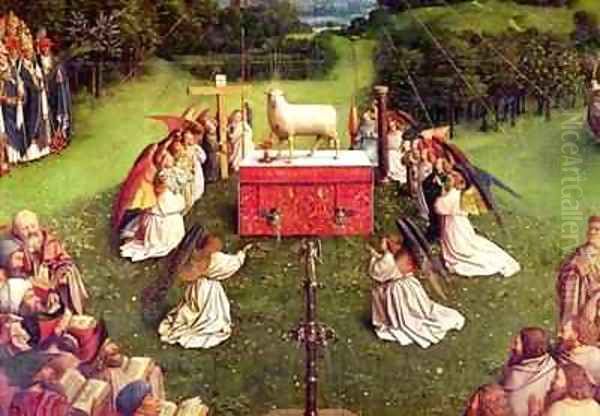
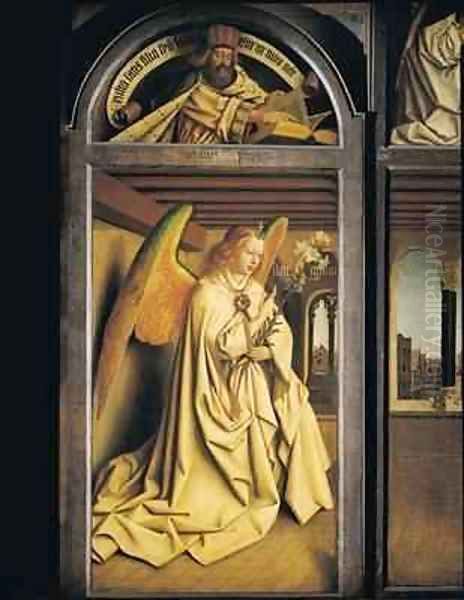
The commission itself speaks to the rising status of lay patrons in the 15th century, who sought to express their piety and secure their salvation through grand artistic endeavors. The altarpiece, completed and installed in 1432, is a multi-paneled work. When closed, it displays an Annunciation scene, portraits of the donors, and figures of St. John the Baptist and St. John the Evangelist, along with prophets and sibyls. When open, it reveals a dazzling celestial vision centered on the Adoration of the Mystic Lamb, surrounded by choirs of angels, saints, martyrs, pilgrims, hermits, and judges, all set within a verdant, minutely detailed landscape. The upper register features a majestic depiction of God the Father (or Christ Pantocrator), flanked by the Virgin Mary and John the Baptist, with musical angels and figures of Adam and Eve.
The inscription on the frame states: "The painter Hubert van Eyck, greater than whom no one was found, began [this work]; and Jan, his brother, second in art, having carried out the task at the expense of Joos Vijd, invites you by this verse, on the sixth of May, to look at what has been done [1432]." This quatrain has fueled endless debate. Most scholars agree that Hubert was responsible for the overall design and began the painting, likely completing significant portions before his death in 1426. Jan then took over the project, bringing it to completion. The challenge lies in discerning the specific contributions of each brother. Some art historians, like Emil Renders in the 1930s, even controversially suggested Hubert might have been a largely legendary figure, with Jan being the primary or sole genius. However, archival evidence supports Hubert's existence and activity.
Stylistic analyses have attempted to differentiate their hands. Hubert is often credited with a more archaic, monumental, and perhaps spatially grander vision, evident in parts of the composition and the overall iconographic scheme. Jan's contribution is seen in the refined oil technique, the luminous surfaces, the exquisite rendering of textures (jewels, fabrics, foliage), and the psychological depth of the figures. The seamless integration of these elements, however, speaks to a shared workshop practice or Jan's remarkable ability to unify his brother's initial concept with his own evolving style. The depiction of St. Christopher, a patron saint of travelers and protector against sudden death, on the exterior, might also subtly allude to Joos Vijd's worldly affairs or his charitable concerns.
Artistic Context and Contemporaries
The Van Eyck brothers did not emerge in a vacuum. They were part of a vibrant artistic milieu in the Burgundian Netherlands, a region experiencing unprecedented economic prosperity. This wealth fueled a demand for art, both religious and secular.
Robert Campin (c. 1375 – 1444), often identified with the Master of Flémalle, was a slightly older contemporary active in Tournai. Works attributed to Campin, such as the Mérode Altarpiece and the Werl Triptych, exhibit a robust realism and a fascination with domestic settings imbued with complex religious symbolism, characteristics that resonate with the Van Eycks' approach. Campin's workshop was a significant training ground, and it's plausible there were interactions or shared influences between these artistic centers. The use of everyday objects as disguised symbols and the meticulous rendering of textures are common threads. For instance, the convex mirror in Jan van Eyck's Arnolfini Portrait finds a parallel in the reflective surfaces seen in works associated with Campin, suggesting a shared interest in optical effects.
Rogier van der Weyden (c. 1399/1400 – 1464), another giant of Early Netherlandish painting and likely a pupil of Robert Campin, became the official painter of Brussels. While Jan van Eyck excelled in static, observational realism and luminous surfaces, Van der Weyden was renowned for his emotional intensity, dynamic compositions, and poignant portrayal of human suffering, as seen in his Descent from the Cross. His style, though different, built upon the technical foundations established by the Van Eycks, particularly in the use of oil glazes.
Other important figures of this era include Petrus Christus (c. 1410/1420 – 1475/1476), active in Bruges after Jan van Eyck's death. He is often considered Jan's closest follower, adopting his predecessor's meticulous technique and interest in portraiture, as seen in Portrait of a Carthusian. Christus also experimented with linear perspective, showing an awareness of Italian Renaissance developments.
The Limbourg Brothers (Herman, Paul, and Johan), active slightly earlier and primarily as manuscript illuminators for patrons like the Duke of Berry, created the famous Très Riches Heures. Their work, with its exquisite detail and nascent naturalism in landscape and genre scenes, represents a parallel development in a different medium, sharing the Northern European penchant for intricate depiction.
Further artists who shaped and were shaped by this period include Dieric Bouts (c. 1415 – 1475), known for his solemn figures and early sophisticated use of perspective, particularly in works like the Altarpiece of the Holy Sacrament. Hans Memling (c. 1430 – 1494), though German-born, became a leading painter in Bruges after Christus, known for his serene and elegant compositions, often blending the influences of Van Eyck and Van der Weyden. Hugo van der Goes (c. 1430/1440 – 1482), active in Ghent, created the monumental Portinari Altarpiece, a work whose intense realism and emotional depth had a significant impact when it was sent to Florence.
Even earlier figures like Melchior Broederlam (c. 1350 – c. 1411), who painted the wings of an altarpiece for the Chartreuse de Champmol, demonstrated the emerging Northern interest in naturalistic detail and landscape, prefiguring the achievements of the Van Eycks. The artistic landscape was rich and interconnected, with painters influencing one another through shared patrons, workshop practices, and the circulation of ideas and artworks.
The Van Eyck Legacy: Revolutionizing European Art
The impact of Hubert and, particularly, Jan van Eyck on the course of Renaissance painting was profound and multifaceted. Their innovations resonated not only within the Netherlands but also across the Alps into Italy and other parts of Europe.
The Oil Painting Revolution: While not the inventors of oil paint, the Van Eycks, especially Jan, perfected its use. Their technique involved applying multiple thin layers of translucent oil glazes over a light-reflecting ground (often gesso). This allowed for unparalleled depth of color, subtle tonal modulations, and the rendering of light with extraordinary realism. Details like the gleam of metal, the softness of fur, the transparency of glass, and the texture of skin were captured with astonishing fidelity. This technical mastery became a hallmark of Netherlandish painting and was eagerly studied and adopted by artists elsewhere. Italian artists like Antonello da Messina (c. 1430 – 1479) are believed to have played a crucial role in transmitting these oil techniques to Venice, profoundly influencing painters like Giovanni Bellini. Even Leonardo da Vinci (1452-1519), with his sfumato, benefited from the expressive potential unlocked by oil paints.
A New Vision of Realism: The Van Eycks pushed the boundaries of mimesis. Their works are characterized by an almost microscopic attention to detail, where every element, no matter how small, is rendered with precision. This "disguised symbolism," where ordinary objects within a scene carry deeper religious or iconographic meanings, became a defining feature of Early Netherlandish art. The Arnolfini Portrait, for example, is rich with such details – the single lit candle, the discarded clogs, the dog, the fruit – all contributing to a complex symbolic program within a seemingly straightforward depiction of a contemporary interior. This intense focus on the particular and the tangible offered a new way of seeing and representing the world, contrasting with the more idealized forms prevalent in the Italian Renaissance, exemplified by artists like Masaccio (1401-1428), who was pioneering linear perspective and monumental human forms in Florence around the same time.
The Art of Portraiture: Jan van Eyck was a consummate portraitist. Works like the Portrait of a Man in a Red Turban (often considered a self-portrait) and the Portrait of Margaret van Eyck (his wife) exhibit a keen psychological insight and an unflinching depiction of the sitter's features. The Arnolfini Portrait is revolutionary not only for its realism and symbolism but also as an early example of a full-length double portrait of non-aristocratic individuals in a domestic setting. His ability to capture individuality set a new standard for portraiture that influenced generations.
Enduring Influence: The fame of Van Eyck's work spread rapidly. His paintings were sought after by Italian patrons, and Northern artists traveling to Italy, or Italian artists traveling north, helped disseminate his style and techniques. Later Northern masters, such as Albrecht Dürer (1471-1528), greatly admired Van Eyck and studied his methods. Even centuries later, artists continued to marvel at the brilliance and durability of his colors and the precision of his execution. The meticulous realism of the Van Eycks laid a foundation for later developments in genre painting and still life in the Netherlands.
Representative Works Beyond the Ghent Altarpiece
While the Ghent Altarpiece is their most famous endeavor, Jan van Eyck's individual genius shines through in several other key works.
The Arnolfini Portrait (1434), housed in the National Gallery, London, depicts the Italian merchant Giovanni di Nicolao Arnolfini and his wife, presumably in their Bruges home. Its intricate detail, complex symbolism (possibly relating to marriage or betrothal), and the famous convex mirror reflecting the entire room and two additional figures (one perhaps Van Eyck himself) make it one of the most analyzed paintings in art history. The artist's prominent signature, "Johannes de Eyck fuit hic 1434" (Jan van Eyck was here, 1434), adds another layer of intrigue.
The Madonna of Chancellor Rolin (c. 1435), in the Louvre, Paris, shows Nicolas Rolin, the powerful Chancellor of Burgundy, kneeling in prayer before the Virgin and Child. The painting is remarkable for its meticulous rendering of textures, the expansive landscape visible through the loggia, and the equal visual weight given to the donor and the divine figures, reflecting the growing status of patrons.
The Madonna in the Church (c. 1438-1440), in the Gemäldegalerie, Berlin, is a small but powerful panel depicting the Virgin Mary standing majestically within a Gothic cathedral. The play of light streaming through the stained-glass windows and illuminating the architecture is a testament to Jan's mastery of light and space, creating an atmosphere of profound spirituality.
Hubert's independent works are harder to identify with certainty due to the scarcity of documentation and signed pieces. Some scholars have tentatively attributed works like The Three Marys at the Sepulchre (Museum Boijmans Van Beuningen, Rotterdam) partly to Hubert, or at least to the early phase of the Van Eyck workshop, though such attributions remain debated. The primary focus for Hubert remains his foundational role in the Ghent Altarpiece.
Conclusion: Architects of a New Artistic Era
Hubert and Jan van Eyck were more than just skilled painters; they were artistic visionaries who fundamentally altered the landscape of European art. Hubert, though shadowed by time, laid crucial groundwork, particularly with the initial conception of the Ghent Altarpiece. Jan, with his unparalleled technical skill and keen observational powers, brought the potential of oil painting to its zenith, creating works that continue to astound with their luminosity, detail, and psychological depth.
Together, they defined the essence of the Early Netherlandish Renaissance, characterized by its meticulous realism, complex symbolism, and profound spirituality. Their innovations in oil painting technique, their approach to portraiture, and their ability to capture the tangible world with unprecedented fidelity provided a powerful artistic language that influenced countless artists, from their contemporaries like Robert Campin and Rogier van der Weyden to later masters across Europe. The Van Eyck brothers stand as enduring pillars of art history, their legacy woven into the very fabric of Western painting.